Parallel Play / Groupmuse


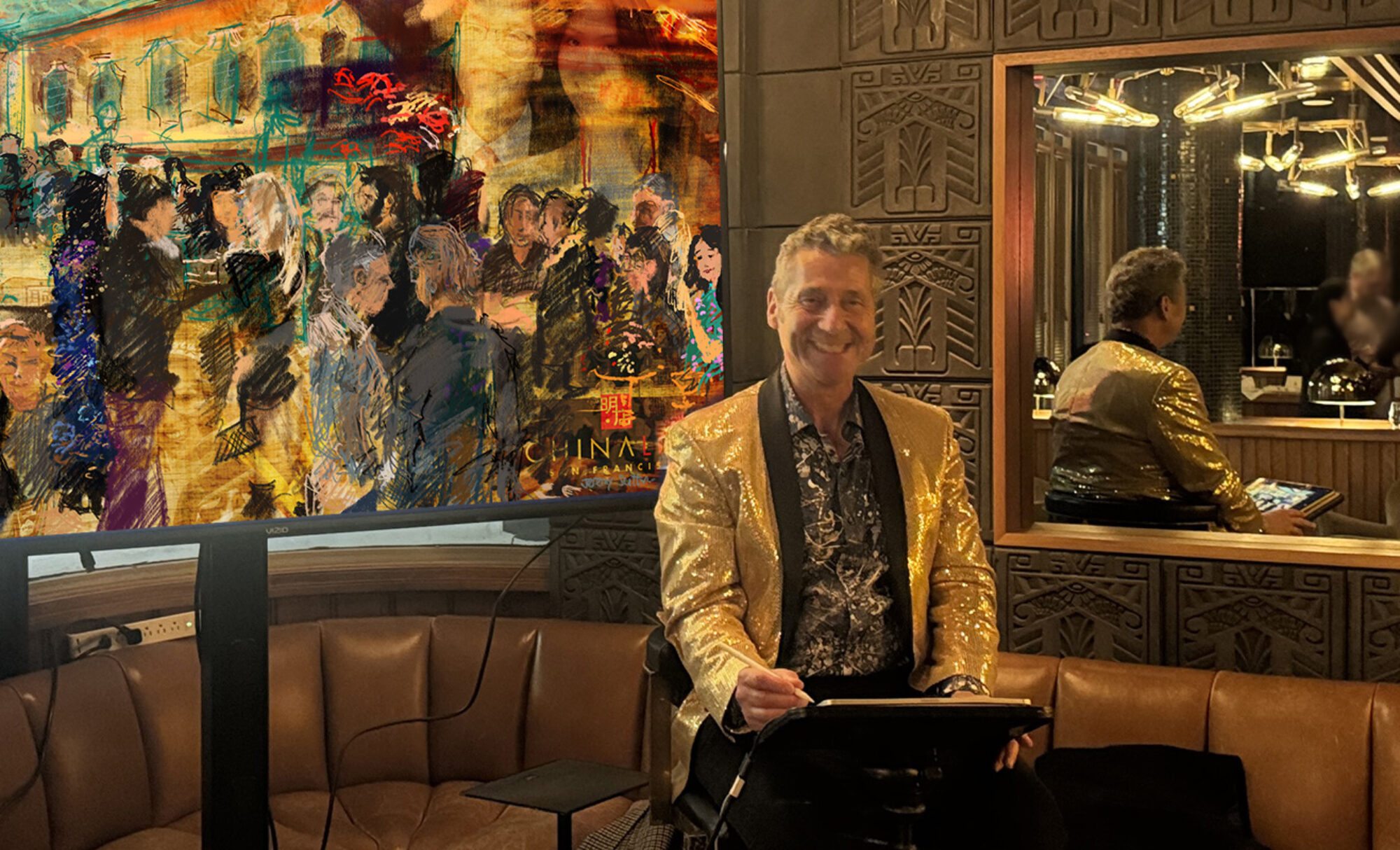
In this multi-sensory extravaganza with two musicians and two artists, we performed as a sonic/visual ensemble. This performance was part of the Groupmuse series.
Violin: Mélanie Clapiès
Cello: James Jaffe
Artist (paper): Peggy Gyulai
Artist (iPad): Jeremy Sutton


iPad Pro, Apple Pencil, Procreate app

And here is an example of how my artwork was featured on the Groupmuse page for James and Mélanie’s Halloween 2020 concert:

Generations

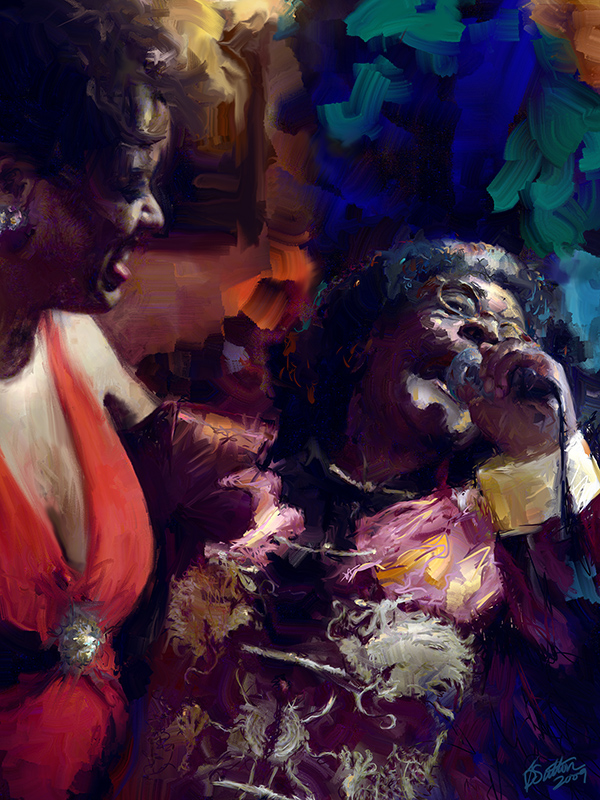
On April 22, 2009, jazz and blues vocalist Kim Nalley was singing at Le Colonial, San Francisco. Myself and many other local Lindy Hop swing dancers were filling the dance floor enjoying Kim’s amazing music. Then at one point Kim asked her grandmother, who she called Gammy, and was visiting from the east coast and with whom Kim was very close to, to join her in a song. They sang the most moving and beautiful rendition of “When The Saints Go Marching In”. It moves me just to think back to that moment. This painting depicts that moment.

Please join Kim and I this Saturday, August 1st, at 10am Pacific on Zoom for The Portrait Conversation.

The Illusionist


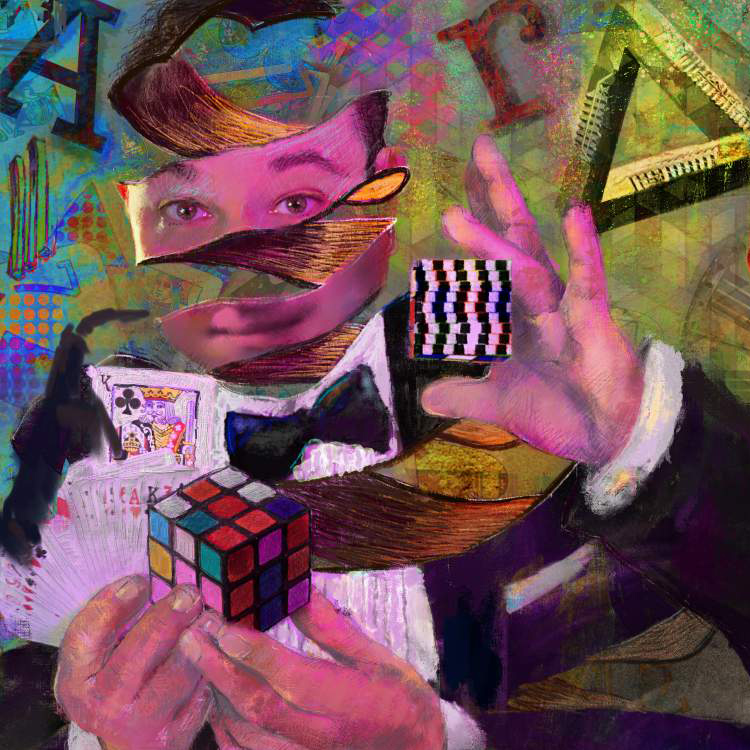
This painting depicts comedic magician (and illusionist) Robert Strong. It started life being created 100% using the Procreate app on an iPad Pro with an Apple Pencil as an entry in their annual Illusion-themed Art Prize contest (which it wasn’t selected for). Then I continued in Corel Painter 2021 on a MacBook Pro with a Wacom Intuos Pro pen tablet to the state you see it shown here, which I call the “final” state…for the moment… As Leonardo da Vinci famously said: “art is never finished, only abandoned.”

Now it’s test-time! See how many illusions and historical references you can find embedded and hidden away in this artwork. I counted at least 18.

You may get a few clues if you carefully watch this time-lapse replay video showing the Procreate portion of the creative process (this video is also an Augmented Reality overlay on the image which you can view with the AR app Artivive):


Print delivered to The Illusionist himself!
(animated GIF photos: Peggy G)

Cosmo Alleycats at Club Deluxe


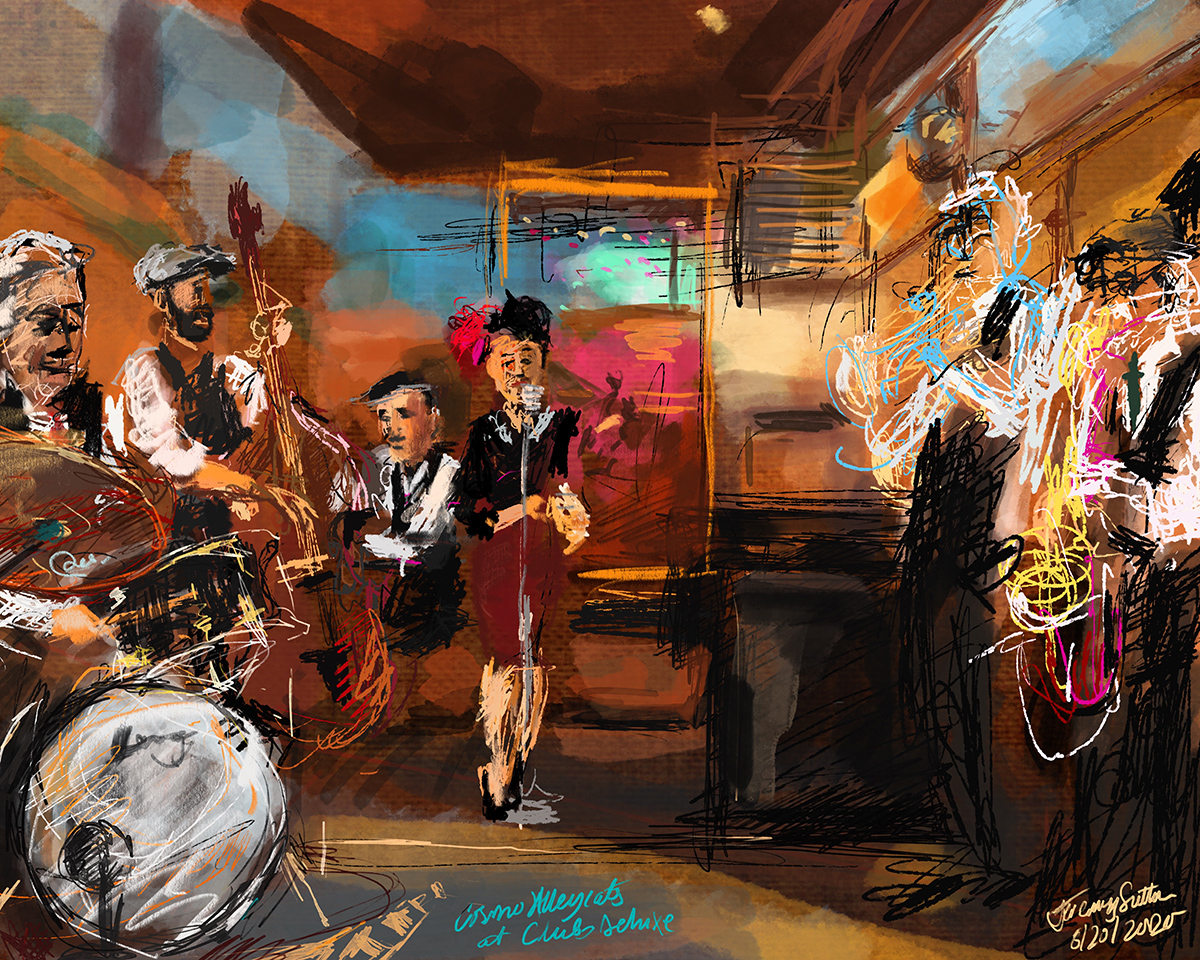
This painting was created live at a performance of The Cosmo Alleycats playing in the historic and iconic Club Deluxe – a one-of-a-kind bar nestled in the heart of the Haight/Ashbury district of San Francisco (actually almost at the corner of Haight and Ashbury!). This live performance was created as a demonstration of unique creative cross-disciplinary entertainment, Parallel Play, for virtual conferences and events. Thank you to The Cosmo Alleycats’ co-managers Noam and Emily for arranging to bring their fabulous band to participate in this live music/art recording/demonstration; to Peggy G. for the videography, to Jeremy C. for sound, to Sarah W. for the use of her fabulous Club Deluxe; and, of course, to all the musicians who played that afternoon. The band comprised of (left to right as depicted in the painting) Mike Burns – Drums; Steve Height – Upright Bass; Noam Eisen – Piano, Hammond B-3 Organ & Vocals; Emily Day – Lead Vocals and Percussion; Andrew Storar – Trumpet; and Pete Cornell – Sax & Clarinet.

In this video you see the whole time-lapse replay of my painting.

Here are some photos taken at the session by Peggy G.:


My Window


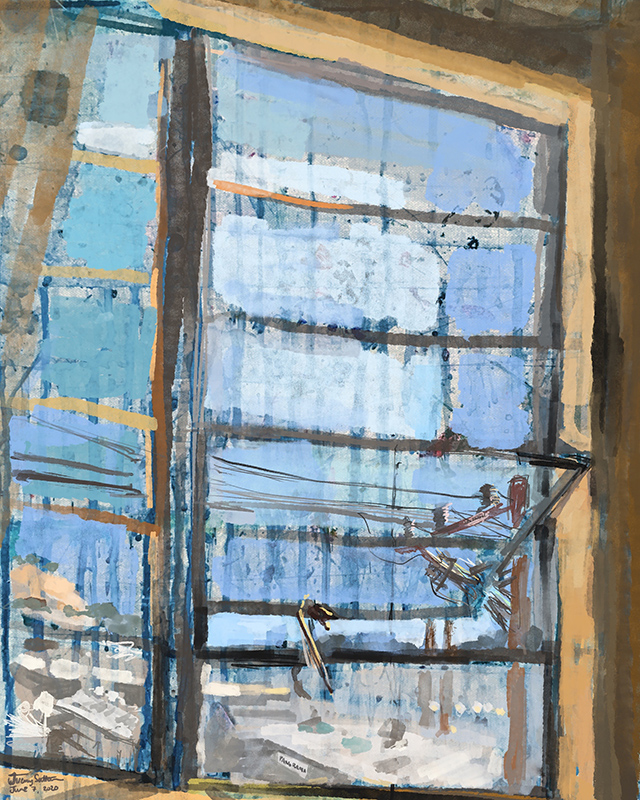
This sketch was created from observation of a window in my studio. I used an iPad Pro, Apple Pencil and Procreate app. The view looks out over the Mission district of San Francisco with Bernal Heights Hill visible on the horizon.

Crazy Wonderland


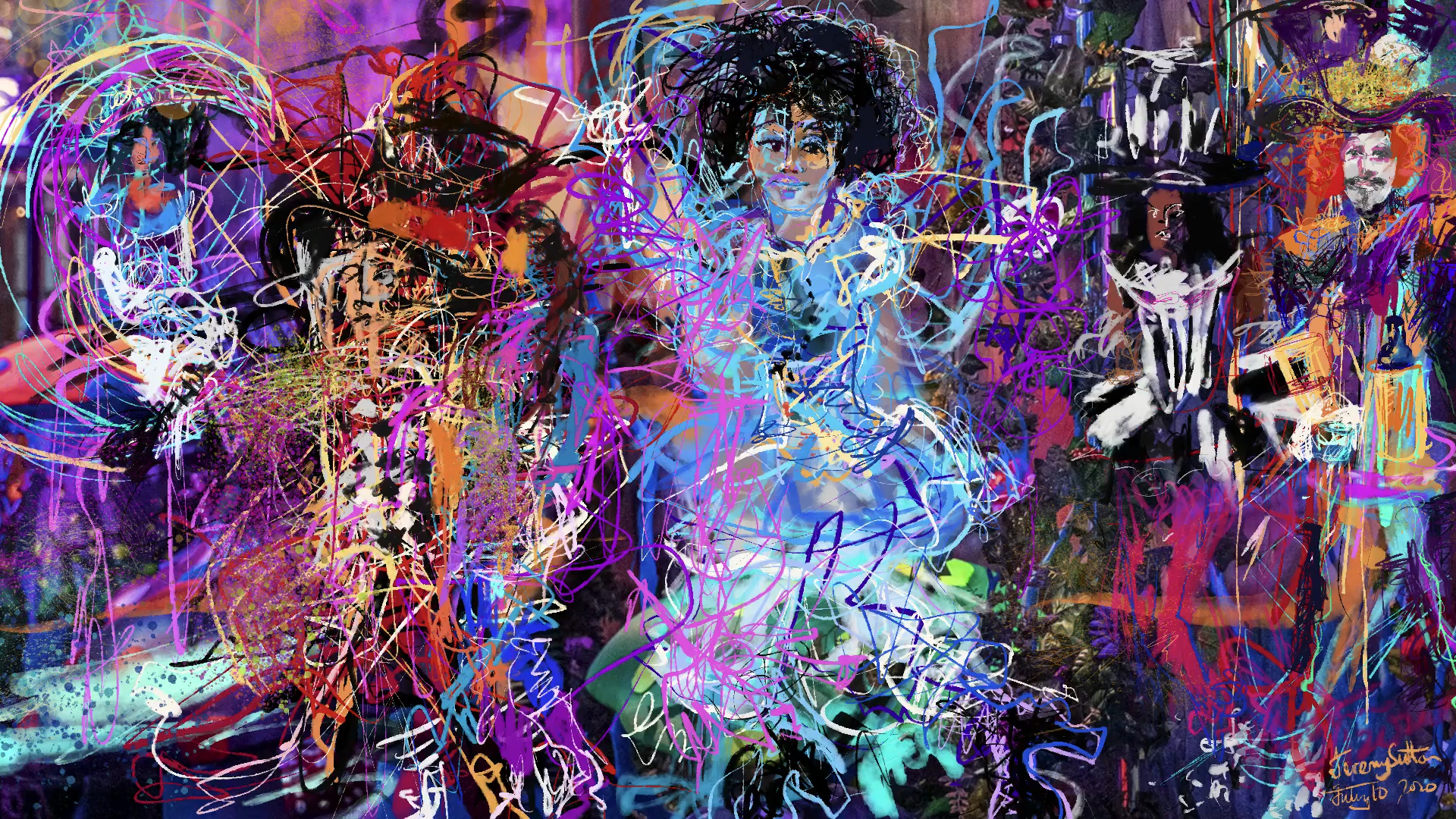
This painting depicts Alice in Wonderland themed characters from Earth Circus. It was created live on the iPad using Procreate as the characters performed.

This was preparation for a virtual group art activity called the Mad Hatter Virtual Art & Tea Party which is a collaborative art experience option offered for online conferences and events.

Here’s the replay of the painting:


Rip It Up!

Well, it’s Saturday night….

…and I just got paid
(well, not quite, since it’s
shelter-in-place and sit tight…),
Fool about my money, don’t try to save,
My heart says go go, have a time,
‘Cause it’s Saturday night and I’m feelin’ fine,

I’m gonna rock it up, I’m gonna rip it up,
I’m gonna shake it up, gonna ball it up,
I’m gonna rock it up, and ball tonight.

‘Long about ten I’ll be flying high,
Walk on out unto the sky,
But I don’t care if I spend my dough,
‘Cause tonight I’m gonna be one happy soul…

“Rip It Up” written by Robert Blackwell and John Marascalco. It was first released by Little Richard in June 1956.

RIP (it up) Mr. Little Richard, King (and Soul) of Rock ‘n’ Roll

I started dancing as a teenager to Little Richard’s music. The energy got into my feet and never left! After initially learning “the bop” from my buddy Drew, I would copy the Teddy Boy dance moves at the local rock ‘n’roll dance place, The Royalty, in Southgate, North London (now a Fitness center and Marks & Spencers!)

In the 1990s I went to see Little Richard perform at the Circle Star Theater in San Carlos, just off the 101. The stage rotated slowly throughout the show. At one point Little Richard invited some of the audience to get up on stage and dance! Well, you can guess who jumped up like a shot!! Yes, me:-)

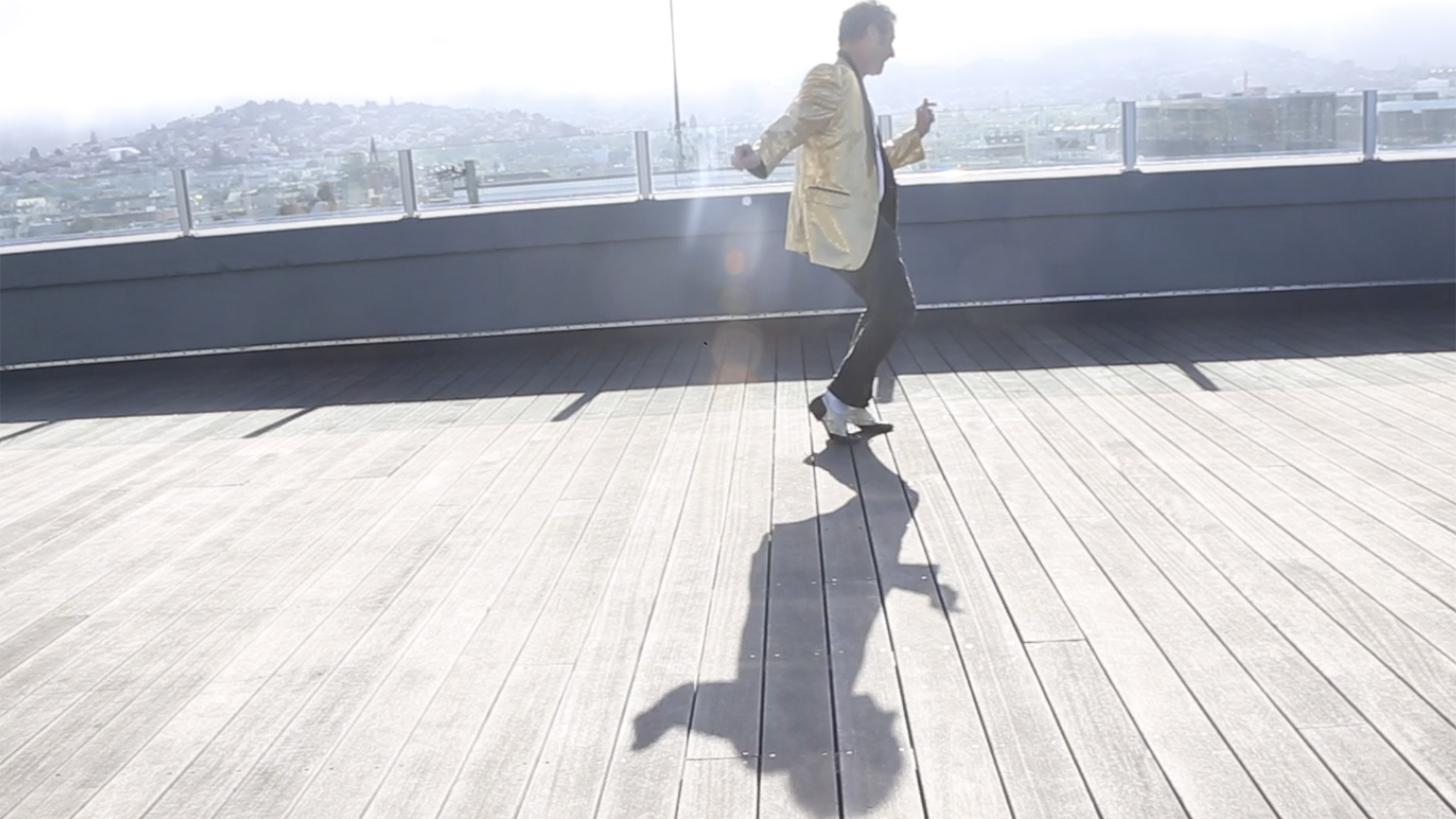
Though many years later the “Rip It Up” tribute on this Saturday night that you see in the video at the top of this page has some of the same moves I stole at the Royalty and danced on stage at the Circle Star!!

(Thank you, Peggy, for the great camera work!:-)

Meditation


Meditation, 10 in x 14 in, ballpoint pen and 4B pencil on 140 lb 100% cotton cold pressed Arches watercolor paper

This sketch was made from direct observation of Rodin’s beautiful sculpture Meditation (or Inner Voice) in the Rodin Sculpture Garden at the The Iris & B. Gerald Cantor Center for Visual Arts at Stanford University (Cantor Arts Center).

Palace of Fine Arts

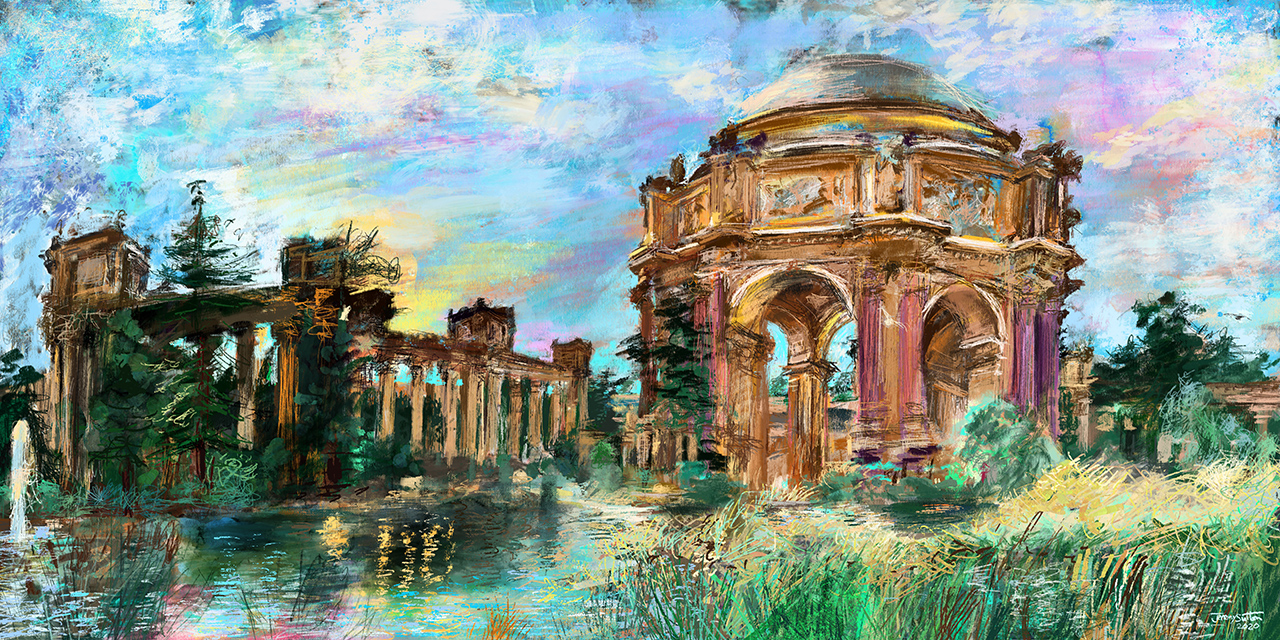
This painting was created outdoors (en plein air) over a period of weeks in numerous sessions overlapping with the early part of the City and State “stay-in-place” COVID-19 orders, using an iPad Pro, Apple Pencil and the Procreate app. Every brush stroke was made without photographic reference, from direct observation, as I sat at the Palace of Fine Arts, a magnificent creation designed by Bernard Maybeck for the 1915 Panama-Pacific International Exposition in San Francisco. Maybeck was inspired by the ruins of ancient Greek and Roman civilizations. A beautiful set of “ruins” that represent vanquished and mortal grandeur, this magnificent setting and architectural masterpiece was only intended as a temporary structure that would last 6 months. Instead, though, through popular demand it has endured. Now renovated and seismically retrofitted, it is one of the iconic “must sees” of any visit to San Francisco!


This video, which I use for the augmented reality (AR) video overlay, shows the time-lapse replay of the painting process plus some shots of the scene as I painted. You can experience the AR overlay yourself on your mobile phone by installing the free app Artivive and then looking at the final artwork through that app.


20″ x 40″, framed artwork, extended through use of the augmented reality free app Artivive.

“The Palace of Fine Arts was seen as the embodiment of Maybeck’s elaboration of how Roman architecture could fit within a California context. Maybeck said that the popular success of the Palace was due to the absence of a roof connecting the rotunda to the art gallery building, along with the absence of windows in the gallery walls and the presence near the rotunda of trees, flowers and a water feature.” And on the sign at the edge of the lagoon it further adds: “Maybeck also believed that architectural elements should come together like notes in a musical score, eliciting emotional responses from the viewer. He designed the Palace of Fine Arts to evoke the sadness and beauty of looking at a Roman ruin. If you visit the Palace repeatedly, you will notice that the mood is rarely the same; weather and time of day conspire to change the play of light and shadow over it’s surface.” explains Maybeck.

Further context is found in a wonderful article titled Joy in the Act of Drawing: Maybeck’s Palace of Fine Arts: “The Palace of Fine Arts was one of the principal buildings of the Panama-Pacific International Exposition, which took place in San Francisco in 1915. The exposition celebrated the completion of the Panama Canal, and its main theme was the bond forged between the East and the West. Among the reasons that San Francisco was chosen over other West Coast cities was its swift recovery from the 1906 earthquake.12 The city’s resuscitation demonstrated its physical resilience and spiritual energy. Rebuilding the entire city in a very short period of time also demonstrated the business community’s ability to tackle large projects. However, some of the exposition’s events and projects were designed to convey a very different sentiment—the memory of a great loss and an appreciation of the fragility of human life and creation. A pavilion, designated to house an art exhibition, was to become a natural site to display melancholy, while the rest of the fair was to exude the optimism of industrial capitalism expanding around the globe, connecting the Pacific and Atlantic Oceans, bridging East and West.”

I repeatedly returned to the Palace of Fine Arts over a period of several months, always sitting in the same place at roughly the same time of day (late afternoon until sunset). I saw a different lighting and mood every time! Thus this painting depicts a myriad of moods, lighting conditions and skies. You can see that in the time-lapse replay. That’s the beauty of plein air painting over time and something that can’t be painted from referring to a single photograph. The more I observed the more I saw. There is magic in the air at the Palace of Fine Arts.

The Palace of Fine Arts signifies the rebirth of the City literally rising out of the ashes of the 1906 earthquake and fire, and saying “we’re back in business, come and visit!” Located at the edge of the lagoon (also designed by Maybeck as part of the installation), at the historical edge of the City (on reclaimed land). As the name implies the function, besides beauty, was to serve as an exhibition space for artworks from around the world (part of that space then became used by the Exploratorium for many years). As an interesting side note, because the First World War had just broken out in Europe a year before the show, the organizers assumed that many European countries wouldn’t be able to get their artworks to California. They therefore invited many additional Californian artists to exhibit. In the end the European art did arrive and they ended up with a much larger exhibition of art than originally envisaged!